

Blog
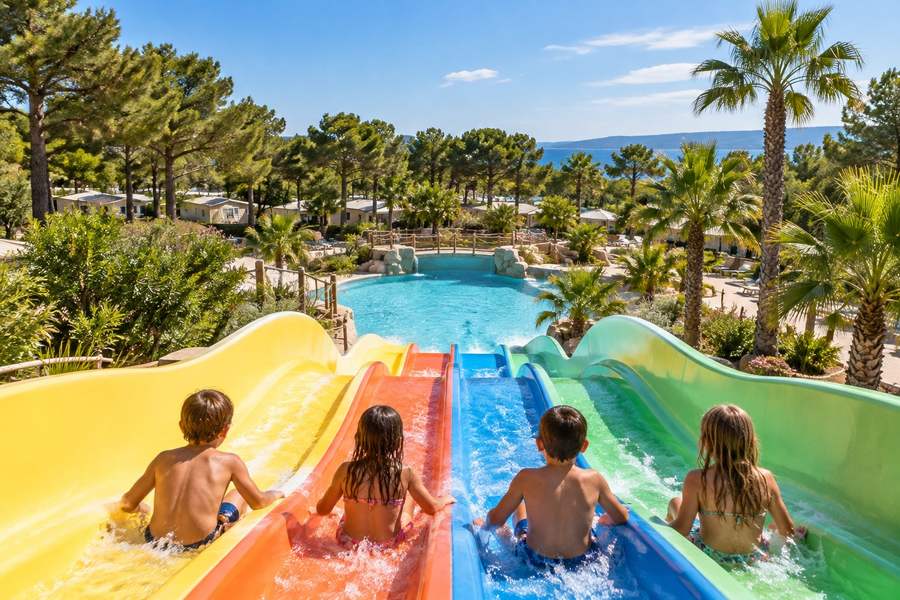
The pentagliss is one of the most popular slides in water parks and at campsites. Its parallel, wavy lanes let several riders set off at the same time and race each other to the end. Less dramatic than a kamikaze, more fun than a simple slide, it appeals to children and parents alike.
Here is how a pentagliss works, from what age you can try it, the safety rules to follow and where to find one during your campsite holiday.
| Information | At a glance |
|---|---|
| Definition | Water slide with several open, parallel, wavy lanes |
| Number of lanes | Usually 3 to 6 |
| Position | Seated, lying on the back or face down depending on the instructions, sometimes on a sliding mat |
| Sensations | Moderate: speed and small bumps, no vertical drop |
| Audience | Children from around 6 to 8 years, depending on the minimum height displayed |
| Arrival | In a landing pool or a braking lane |
A pentagliss is a water slide made of several open lanes side by side, which descend in successive waves. Its name comes from “penta”, meaning five, in reference to the five-lane models, but the term is also used for versions with three, four or six lanes. Manufacturers also call it a multi-lane slide or a “racer”.
The principle is simple: each rider takes a lane, the starts happen at the same time and the first to reach the pool has won. The bumps give small feelings of lift-off without ever leaving the lane, which makes it an attraction halfway between a family slide and sportier rides.
To discover the most impressive installations, read our selection of the most spectacular slides in campsite water parks.
There is no single age: each operator sets its own access conditions, most often a minimum height displayed at the foot of the slide, sometimes combined with the ability to swim, since the landing is often in a pool. In practice, most children can slide alone on a pentagliss from around 6 to 8 years old. The youngest make do with paddling pools and mini slides in the play areas.
In France, slides in pools and bathing areas open to the public must comply with the NF EN 1069 standard, which sets the safety, design and testing requirements for this equipment. As for riders, a few rules prevent most accidents:
Back in the pool, keep the basic rules of swimming in mind, especially to avoid immersion shock when the water is cold.
Many campsites with a water park offer a pentagliss, often in the heart of the slide area. In Brittany, the Domaine de Pendruc campsite, in Trégunc in Finistère, has a three-lane pentagliss and a spiral slide. On the Hérault coast, the Les Champs Blancs campsite, at Cap d’Agde, combines a four-lane pentagliss with a large tube slide. In the Pyrénées-Orientales, the Les Pins campsite, in Argelès-sur-Mer, has a three-lane slide in a heated water park.
To go further, find all our campsites with slides.
The pentagliss is probably the most sociable slide: you ride it with family or friends, you challenge each other on every descent, and the sensations remain accessible. It is often the first “real” attraction children dare to try on their own. Simply check the minimum height displayed, follow the lifeguard’s instructions and choose a campsite whose water park is heated if you travel out of season.
It is a water slide made of several open, parallel lanes that descend in successive waves. Several riders set off together to race to the landing pool.
The name refers to five-lane models, but installations most often range from three to six lanes depending on the water park.
Each operator sets a minimum height, displayed at the foot of the slide. In practice, most children can slide alone from around 6 to 8 years old, provided they can swim if the landing is in a pool.
No, provided you follow the position indicated, set off one person per lane and wait for the lane to be clear. Public slides must comply with the NF EN 1069 standard.
The pentagliss has several wavy lanes and moderate sensations. The kamikaze is a single, very steep, almost vertical lane, reserved for speed enthusiasts.
Many campsites with a water park offer one, for example Domaine de Pendruc in Trégunc, Les Champs Blancs at Cap d’Agde or Les Pins in Argelès-sur-Mer.
Campsites marked “Partner” are Aimer Camper members and are shown first. All results match your search.


