


guide

Sete cultivates a unique identity in Occitanie: a lively fishing port, canals sailed by boats, a mount dominating the Mediterranean and a pond covered with oyster tables. To know what to do in Sete as a family, it’s best to alternate viewpoints, maritime traditions and gastronomic pleasures. From a campsite with water park near Thau basin, you reach these sites in minutes.
Here are our ten ideas to pace your stay, between sea, culture and gastronomy.
First reflex to dominate the city, Mont Saint-Clair peaks at 183 meters. From the viewpoint, the view sweeps the Mediterranean and Thau pond, near the Notre-Dame-de-la-Salette chapel and its colorful frescoes.
Visitor favorite: the sunset over the lagoon, when shellfish tables stand out in silhouette.
Practical information:
Impossible to understand Sete without its nautical jousts. Two jousters in white face off, lance and shield in hand, standing on the platform of their boat. The tradition dates to the inauguration of the port in 1666.
Visitor favorite: the popular atmosphere of the quays, carried by oboes and drums.
Practical information:
Called the “Venetian Languedoc,” Sete reveals itself differently from the water. Boat rides ascend the fishing port and canals, pass under a series of bridges, then head to Pointe Courte and Thau pond, closest to oyster parks.
Visitor favorite: passing by the joust boats moored along the quays.
Practical information:
Head to the largest lagoon in Occitanie. Thau Pond lives at the pace of shellfish farming, with its tables where oysters and mussels mature. The suspended rope farming, born here in the early 20th century, remains unique in the Mediterranean.
Visitor favorite: tasting at a shellfish farm on return from a lagoon excursion.
Practical information:
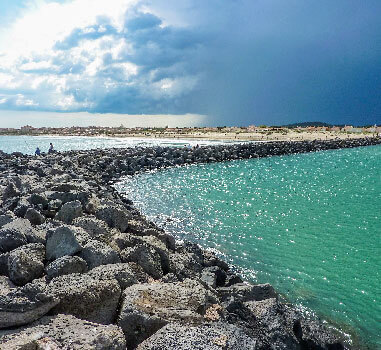
For a swimming day, head to Lido. This sand bar stretches 12 kilometers, from Sete to Marseillan, between sea and pond. The supervised area is at access n°22, with rescue station and access for people with reduced mobility.
Visitor favorite: the space, which allows spreading your towel far from crowds, even in peak summer.
Practical information:
Sete’s belly is visited in the morning. Under the covered market on Aristide-Briand Square, stalls mix fish, Thau shellfish, cheeses and charcuterie. Here you taste tielle, this pie with cuttlefish and tomato sauce, specialty of the city.
Visitor favorite: the sea breakfast, tielle and glass of Picpoul, in the midst of activity.
Practical information:
On the slopes of Mont Saint-Clair, the Paul Valéry Museum combines fine arts and Sete memory. It preserves paintings, Saint Louis posters and a room dedicated to the poet, including the manuscript of the “Marine Cemetery”. Its terrace overlooks the cemetery and Mediterranean.
Visitor favorite: the dramatic view over the marine cemetery, where the poet rests.
Practical information:
Founded by Sete artist Hervé Di Rosa, MIAM, International Museum of Modest Arts, cultivates surprise. It displays popular objects, toys and unusual collections, in a former wine warehouse on the canal.
Visitor favorite: the abundant displays, where every detail holds a discovery.
Practical information:
Sete saw the birth of Georges Brassens, child of the neighborhood. The Georges Brassens Space retraces his life and work through an audioguided journey, punctuated by his songs, from Sete childhood to texts that marked French song.
Visitor favorite: Brassens’ voice in your headphones, accompanying each step.
Practical information:
For an authentic finish, head to Pointe Courte. This fishing neighborhood, squeezed between canals and pond, lines colorful sheds and moored boats, and keeps real village life. Nearby, the fish auction comes alive each afternoon on return of the boats.
Visitor favorite: the unloading of the catch at the auction, at day’s end.
Practical information:
So, which idea to start your discovery of Sete? Find your campsite with water park in Sete, and book accommodation that brings your children close to water slides and you to Sete’s canals.
Spring and early autumn combine pleasant temperatures with more manageable crowds. Summer is still great for water jousting and swimming, though it's best to plan outdoor visits for the morning.
The museums take over: the Paul Valéry museum, the MIAM and the Espace Georges Brassens can easily be visited one after another. A break at Les Halles rounds off a sheltered day nicely.
Yes, the town centre, the canals, Les Halles and the Pointe Courte are all easy to link up on foot. Only Mont Saint-Clair takes some effort, whether on foot via the steps or by car.
Head to the Thau lagoon, particularly Bouzigues and Mèze, where growers serve their oysters right by the water. Some boat trips even include a tasting at an oyster farmer's table.
Lido beach and its supervised area suit the youngest visitors, as does the boat trip along the canals. The playful, colourful MIAM easily captures children's attention.

