

guide
Are you wondering what makes Cap d’Agde so unique? The answer lies beneath your feet. This seaside resort in southern France rests on the remains of a volcano 750,000 years old. From the summit of Mont Saint-Loup to the black basalt cliffs plunging into the Mediterranean, volcanism at Cap d’Agde has shaped landscapes, architecture and identity.
Black sand beach, geological trails, fortified cathedral: here is everything you need to know during your stay at a aquatic park campground in the region.
The Cap d’Agde volcano is not an isolated relief. It is actually a volcanic complex composed of three ancient structures. The first eruptions, occurring approximately 750,000 to 1 million years ago, took place in a submarine environment. They formed characteristic yellow tuffs. A strombolian phase then gave rise to basalt flows that structure the relief of the coastline. According to Futura Sciences, this site marks the southernmost extremity of the Auvergne volcanic chain.
The three cones that make up this complex are distinguished by their altitude:
| Volcano | Altitude | Particularity |
| Mont Saint-Loup | 113 meters | Highest point, former strombolian cone |
| Mont Saint-Martin | 55 meters | Located in the heart of the seaside resort |
| Petit Pioch | 35 meters | The most modest of the three structures |
The volcanic heritage of Cap d’Agde can be discovered on foot and by the seaside. Here are the three major sites to see during your stay in Agde.
Highest point of the complex, Mont Saint-Loup is a former strombolian cone classified as a protected natural area. From its summit, the panorama extends over the entire Languedoc coast, from Sète to Cap Leucate. The hike to reach it represents approximately 6 kilometers in a loop for a 110-meter elevation gain, or 1h30 of hiking. It is one of the most striking points of view to measure the imprint of the volcano at Cap d’Agde on the landscape.
Claire recommends: “Climb Mont Saint-Loup at the end of the day. The sunset over the Mediterranean, with the dark roofs of Agde below, is well worth the trip.”
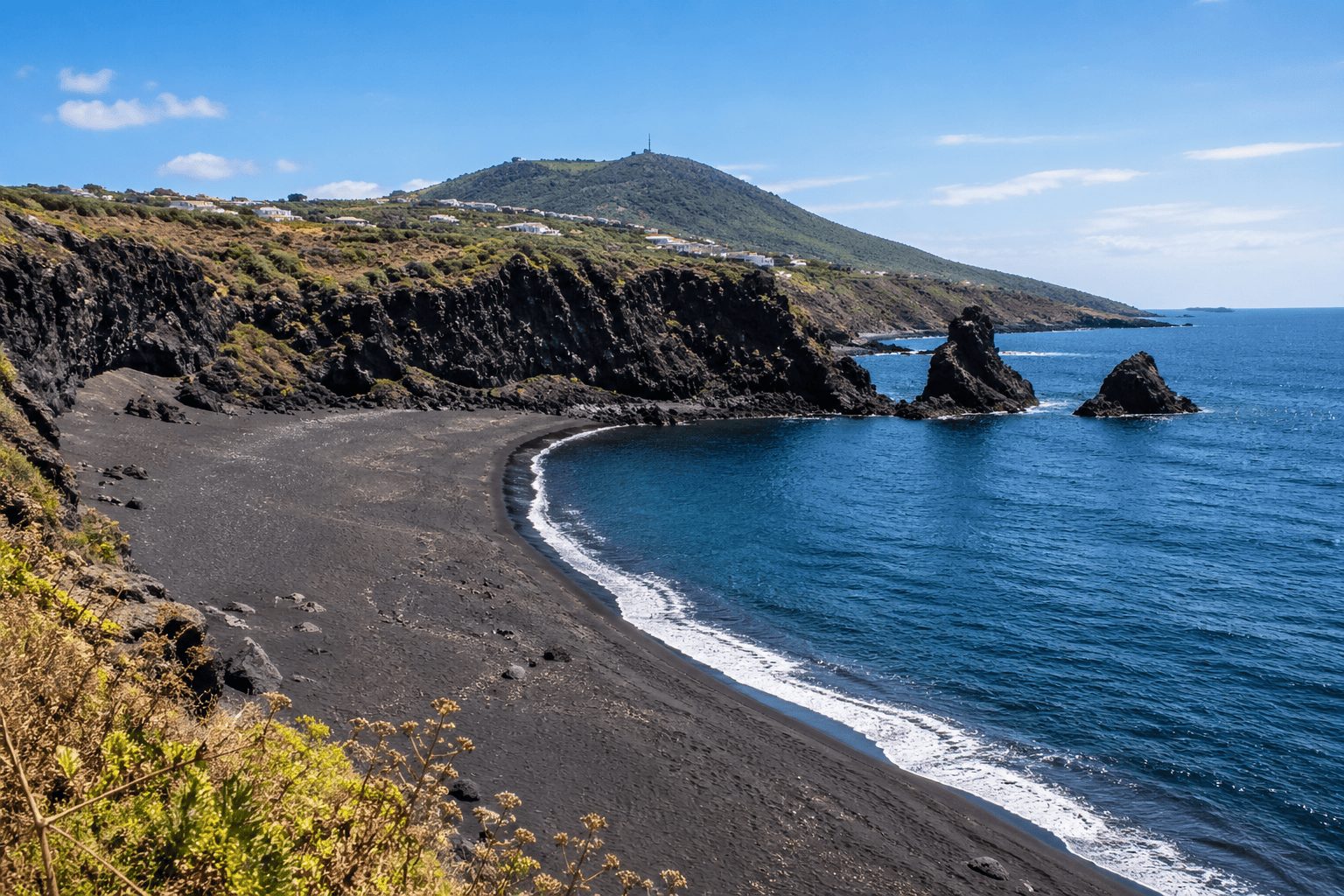
Located in the hollow of basalt cliffs, the beach of Grande Conque is the volcanic jewel of Cap d’Agde. Its black sand comes from millennia of erosion of volcanic rocks by waves and tides. About 200 meters long, this crescent-shaped cove reveals clear water that contrasts with the dark rocks. The Deux Frères rocks, remains of an ancient volcanic cone, stand facing the beach and nurture a local legend well known to the people of Agde!
The volcanic cliffs of Cap d’Agde reveal a striking panorama from the viewpoint located 21 meters above the sea. Below, the underwater trail, accessible in fair weather, offers a marked 400-meter round-trip course in 1 to 4 meters deep water. Educational buoys allow observation of wildlife, flora and immersed volcanic geology at the foot of the cliffs. A unique way to discover Cap d’Agde’s volcanism below the surface.
The Cap d’Agde volcano shaped not only the natural landscape. The dark rock extracted from its flows gave the city its nickname of “black pearl of the Mediterranean”. The Saint-Étienne Cathedral, a fortified building from the 12th century classified as a historical monument, was entirely built in volcanic basalt. Its 2 to 3-meter-thick walls and 35-meter keep testify to the solidity of this stone. Offshore, the Fort of Brescou, erected in 1586 on a basaltic islet, also recalls the submarine origin of this territory, 750,000 years old.
Several hiking routes allow you to explore the geological heritage of Cap d’Agde on foot. Here are the routes best suited for a family outing or enthusiasts:
Claire’s advice: if you are traveling with children, choose an aquatic park campground with covered facilities in the Agde area. You will thus combine discovery of the volcano, walks on the basalt cliffs and retreat to heated pools in case of capricious weather. An ideal formula for a successful family stay near Cap d’Agde.
Are you preparing a stay combining discovery of the Cap d’Agde volcano and family bathing? Discover our aquatic park campgrounds at Cap d’Agde! Enjoy water slides, covered pools and children’s activities just minutes from the black cliffs!
No, the Cap d'Agde volcano is not active. Its last eruption dates back around 750,000 years. It's an extinct volcano of the strombolian type. The volcanic complex comprises three former structures: Mont Saint-Loup, Mont Saint-Martin and Petit Pioch, all completely inactive today with no eruption risk whatsoever.
Traces of the volcano at Cap d'Agde are visible in several places: the black-sand beach of Grande Conque, the basalt cliffs along the coast, Mont Saint-Loup and its panorama, and the lava-stone buildings of Agde's historic centre, such as Saint-Étienne cathedral.
Grande Conque beach is black because of its volcanic origin. The sand comes from the erosion of basalt rock by waves and tides over thousands of years. It's the only black-sand beach in mainland France, direct evidence of the volcanic activity that took place 750,000 years ago at Cap d'Agde.
Yes, hiking Mont Saint-Loup is possible. A loop of around 6 kilometres with 110 metres of elevation gain leads to the summit in about 2 hours 10 minutes. The natural area is protected and closed to motor vehicles. Access may, however, be restricted in summer during fire alerts.

