


guide
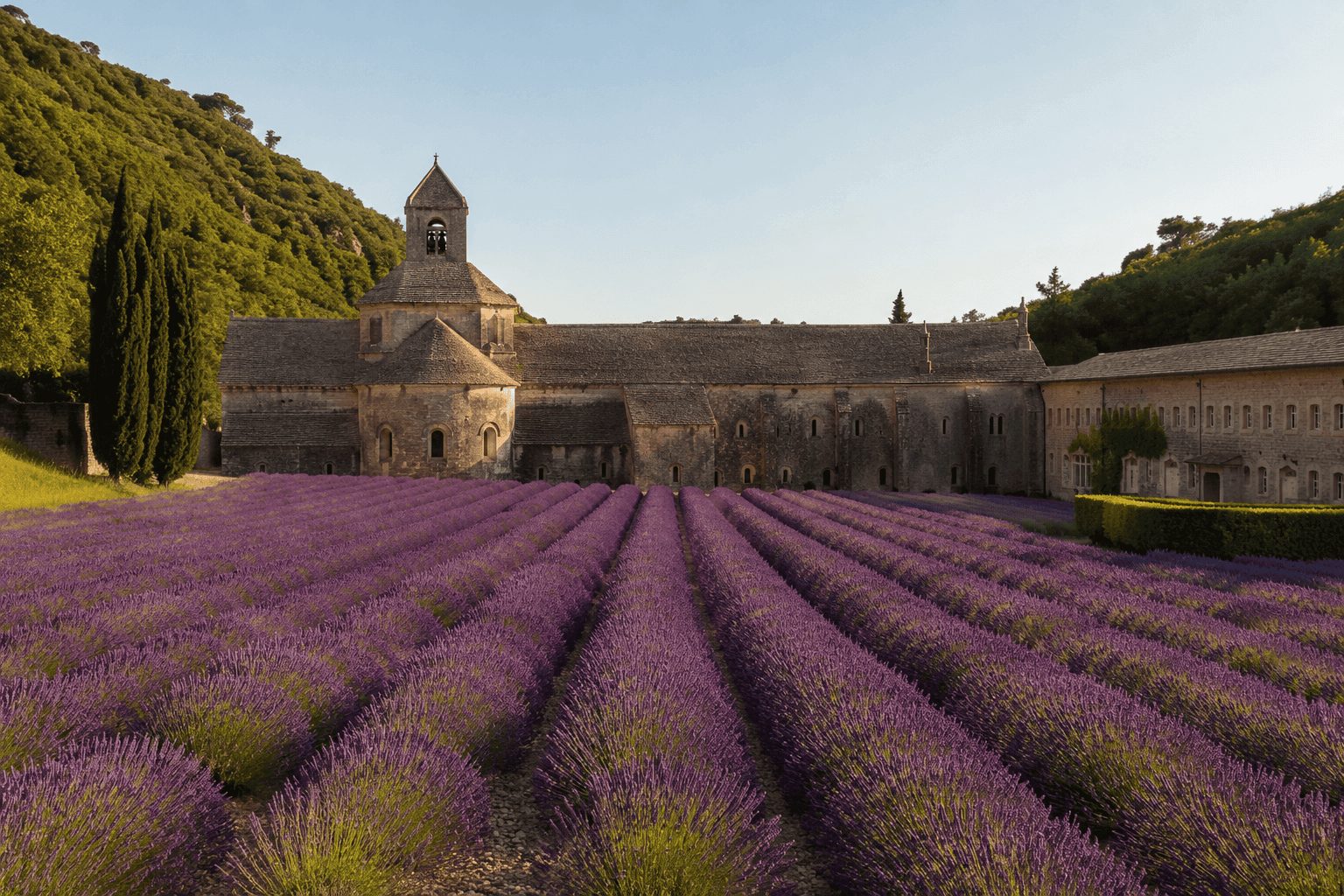
Sénanque Abbey rises in a valley of the Luberon, a few kilometers from Gordes, in Vaucluse. Founded in 1148, this Cistercian monastery still inhabited by monks owes its worldwide fame to its lavender fields that bloom each summer. Planning a getaway to Provence from your camping with water park?
Here’s the site’s history, the best time to admire the lavender, and all the practical information to make the most of your Sénanque Abbey visit!
Sénanque Abbey was founded in 1148 by Cistercian monks from Mazan, in Vivarais, on the austere lands of an isolated valley. This isolated location reflected the order’s ideal of poverty, silence, and simplicity. Construction stretched over nearly seventy years, until the last stone was laid around 1220.
Sénanque forms, with Silvacane and Le Thoronet, the trio nicknamed the three Provençal sisters, witnesses to Cistercian influence in the South. After turbulent centuries, the monastery recovered religious life in 1988 thanks to monks from Lérins Abbey. That’s why Sénanque Abbey remains today a living place of prayer, not a frozen monument.
The lavender at Sénanque Abbey blooms from mid-June to mid-July, peaking often between late June and early July. Flowering begins in June, and flowers reach maturity during the first week of July, just before hand-harvesting.
To enjoy the spectacle fully, keep a few simple markers in mind before you go.
Planted in the 1970s, these lavandin fields offer the distinctive purple palette so characteristic of Provençal postcards.
Théo’s tip: Flowering varies from year to year depending on spring weather. Before heading out, I recommend checking recent photos shared on social media or the official website’s bulletin. You’ll avoid the disappointment of arriving just after harvest and can time your visit for the most beautiful purple moment.
A visit to Sénanque Abbey reveals a remarkably preserved Cistercian complex, where each room tells the story of monastic rigor. You can explore freely or opt for a guided tour of about an hour, ideal for grasping the spirit of the place.
The abbey church illustrates Provençal Romanesque in its most austere form, with its single nave vaulted in broken barrel and its semi-circular apse. The cloister, marked by forty-eight small arcades with sculpted capitals, frames a peaceful garden. Surrounding it are the chapter house, dormitory, refectory, and warming room—the only room once heated in the monastery.
A small community of Cistercian monks keeps the abbey alive to the rhythm of prayer, work, and silence. They cultivate lavandin and harvest honey, transforming and selling them to meet their needs. The shop offers honey, lavender sachets, biscuits, and gifts, perfect for keeping an authentic memory of your visit.
Before planning your visit, here’s the useful information to organize your trip to Sénanque Abbey serenely.
Since the abbey remains an inhabited place of worship, proper dress and quiet are requested inside buildings.
Do you dream of walking through the lavender rows at Sénanque Abbey, then reuniting with your kids at the pool in the evening? Discover our campings with water parks in the Luberon and book a stay that will delight young and old alike!
Yes, Sénanque Abbey can be visited almost all year round, with a few exceptional closures for religious holidays. As the monastic community still lives there, opening hours are built around services. It's therefore best to check opening days and time slots before you go.
The best time to see the lavender at Sénanque is between late June and mid-July. The fields reach their fullest colour then, just before harvest. As flowering is weather-dependent, keep an eye on the site's updates to catch the peak of the purple.
Yes, a community of Cistercian monks has lived at Sénanque Abbey continuously since 1988. They lead a life of prayer, work and silence, following the Rule of Saint Benedict. This presence makes the site a living monastery rather than a mere monument.
Entry to Sénanque Abbey starts at €8 for adults and €4 for children aged 6 to 17. Under-6s enter for free. Reduced rates are available for students and certain groups on presentation of proof.
Sénanque Abbey is reached by car, about 4 km north of Gordes, via a small road that winds down into the valley. Parking is available near the site. In peak season, arrive early, as crowds can sometimes make access tricky.