

guide
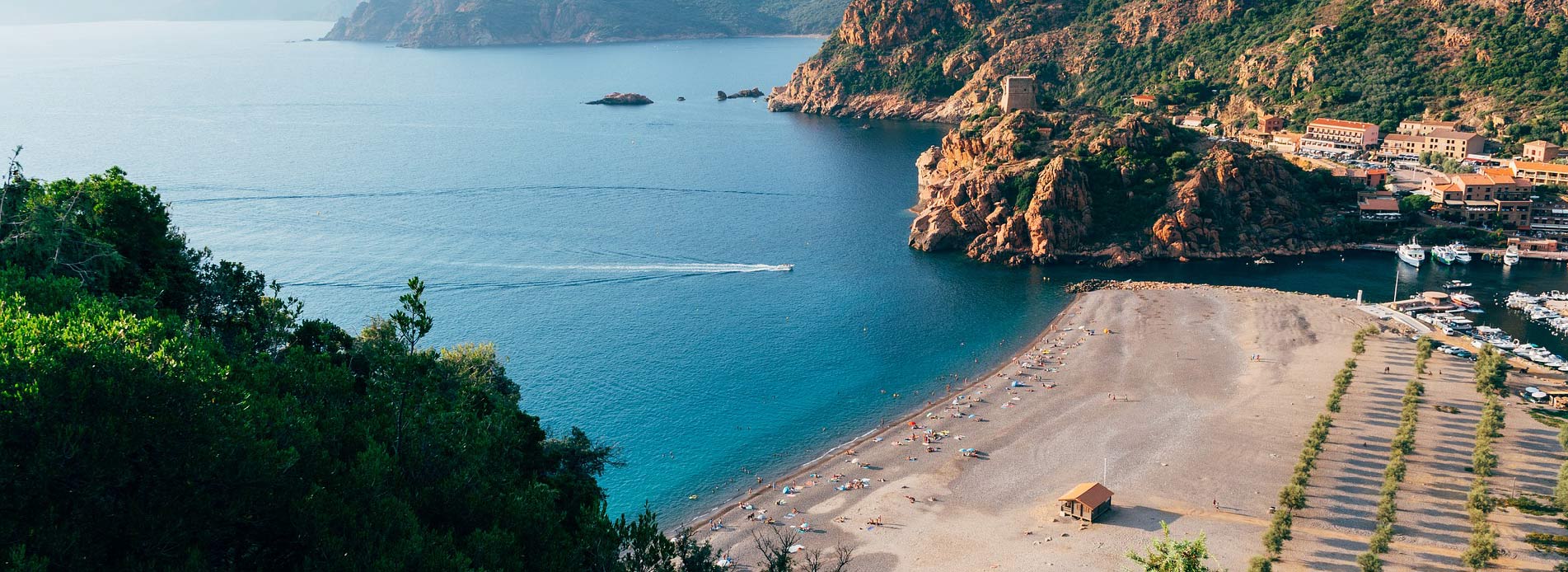
Northern Corsica brings together some of the most beautiful Mediterranean landscapes. From Bastia to Calvi, the coastline alternates fine sandy beaches and secluded coves. Inland, mountains and villages complete the picture. Cap Corse, Scandola Reserve, Agriates Desert: sites to discover abound. Between hikes, swims, and Genoese heritage, each day promises its share of surprises.
In camping with water park or on a road trip, here’s the essentials to prepare your stay.
Northern Corsica abounds with sites to discover, from coastal towns to nature reserves and mountains. Here are the stops you shouldn’t miss.
Bastia, gateway to Upper Corsica, attracts visitors with its old harbor and colorful facades. Heading west, you reach Calvi. Its Genoese citadel overlooks a turquoise bay, with mountains as the backdrop.
The Scandola Nature Reserve is inscribed on the UNESCO World Heritage list. Accessible only by sea from Porto or Calvi, it harbors volcanic cliffs and great marine biodiversity. It’s one of the Mediterranean’s most protected natural sites.
The Agriates Desert covers 15,000 hectares of preserved scrub between Saint-Florent and Île-Rousse. Protected by the Coastal Conservation Service, it also hides the Saleccia and Lotu beaches. Access is by boat, 4×4, or on foot.
Corte, Corsica’s former capital, sits in the heart of the island’s mountains. Its perched citadel overlooks the Restonica Valley. The surrounding gorges attract hiking and freshwater swimming enthusiasts.
Claire’s tip: to discover Scandola, book a boat tour early in the morning. The raking light enhances the volcanic cliffs and the sea stays calm at this hour. You’ll also avoid the crush of midday departures.
The Northern Corsica coast ranks among the island’s most preserved. Here are the beaches worth the detour:
Cap Corse forms a 40 km peninsula north of Bastia. This wild land harbors authentic villages, perched between sea and mountain. Here are 3 worth the visit.
Centuri is a small fishing port at the tip of Cap Corse. Its green-tiled roof houses surround the harbor. It’s also the capital of Corsican lobster. You can taste it in the port’s restaurants.
Nonza overlooks Cap Corse’s west coast. Its Genoese tower and the Church of Sainte-Julie offer wide views over the Gulf of Saint-Florent. Below, the black pebble beach contrasts sharply with the sea’s blue.
Erbalunga sits just 10 km north of Bastia. This fishing village preserves a ruined Genoese tower at the harbor entrance. Each spring, the Cerca procession makes it a cultural gathering not to miss.
A Northern Corsica getaway takes planning in a few steps. To reach the island, two options await you. Ferries connect Marseille, Toulon, or Nice to Bastia’s port. Planes offer direct flights to Bastia and Calvi.
For lodging, camping remains families’ preferred solution. Many establishments line the coast and offer water parks with pools and water slides.
Wanting to explore Northern Corsica as a family while enjoying water activities? Book your stay at a camping with water park in Corsica camping-parc-aquatique.fr and find the ideal camping for your next vacation.
Northern Corsica and Haute-Corse refer to the same geographic area. Haute-Corse is the official name of the department (2B). It covers the entire northern half of the island, from Bastia to Calvi via Corte. The term 'Northern Corsica' is simply more commonly used in everyday language.
Allowing at least 7 days lets you visit Northern Corsica's major sites without rushing. With 10 to 15 days, you can explore Cap Corse, the Agriates and the interior. It all depends on your pace and what you're after.
It all depends on what you're looking for. The north of Corsica is wilder and more mountainous, with a less developed coastline. The south offers more accessible beaches and a more touristy feel. The island's 2 halves complement each other well if you have enough time.
To get to Northern Corsica, 2 main options exist. The ferry departs from Marseille, Toulon or Nice to the port of Bastia. Flights serve Bastia-Poretta and Calvi-Sainte-Catherine airports from several French cities. The ferry crossing takes between 5 and 12 hours depending on the company.
Yes, Northern Corsica suits families perfectly. Several beaches offer shallow water, such as the one at Calvi. Campsites with a water park offer activities for every age. Easy hikes, cultural visits and swimming keep young and old entertained throughout the stay.